

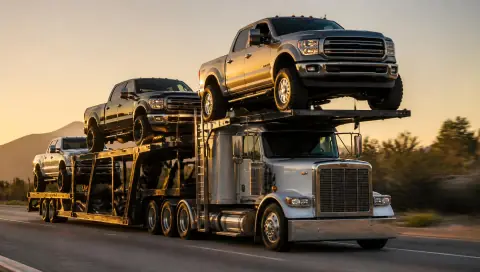
Truck shipping
The Complete Truck Shipping Guide
Cab style, bed length, lift height, tire size and wheel configuration - these five answers set the price of every pickup we move. Here is exactly how much each one costs, with dimensions and weights for every truck built.
Start here
Why trucks price differently than cars
A car hauler is not selling weight. It is selling deck feet and deck height. A standard nine-car open carrier has roughly 75 to 80 usable feet of deck split across two levels, and the whole rig has to stay under 13 feet 6 inches tall and 8 feet 6 inches wide when loaded. Every inch your truck takes is an inch the driver cannot sell to someone else.
That is the entire logic behind truck pricing. A regular cab short bed is 17 feet long and loads anywhere. A crew cab long bed dually on a 6-inch lift with 37s is 22 feet long, 8 feet wide and over 7 feet tall - it can only ride in specific bottom-deck positions, and it often costs the driver a second vehicle. He prices for both.
The five questions below decide your rate. Answer them honestly on the quote form and the number you are given is the number that holds. Leave one out and the driver re-rates the load at pickup, which is the single most common reason a truck shipment goes sideways.
Question 1
Cab style
Regular, extended, crew or Mega Cab
Question 2
Bed length
5.5 ft, 6.5 ft or 8 ft
Question 3
Lift and tires
Inches of lift and tire diameter
Question 4
Wheels
Single rear wheel or dually
Question 5
Vehicle weight
Curb weight and permanent accessories
Pricing
What each configuration and modification actually costs
These are real market ranges on typical lanes, added on top of the base rate for that route and season. They stack - a crew cab long bed with a 6-inch lift and 37s is all three adders, not the largest one.
| Configuration or modification | Typical spec | Price impact | Why it costs more |
|---|---|---|---|
| Regular cab, short bed | Roughly 205–215 in long | Base rate | Shortest pickup footprint. Loads like an SUV and rarely costs a carrier a second slot. |
| Extended / double cab | Roughly 225–235 in long | +$75 to $150 | Adds about a foot and a half of deck length compared with a regular cab. |
| Crew cab, short bed (5.5–6.5 ft) | Roughly 232–244 in long | +$100 to $250 | The most common configuration we ship. Still fits most slots, but the carrier gives up shuffle room. |
| Crew cab, long bed (8 ft) | Roughly 250–266 in long | +$250 to $450 | Over 20 feet. On a 9-car hauler this can cost the driver a partial slot, and he prices the whole load accordingly. |
| Mega Cab / King Ranch-style long cab | Adds 6–8 in of cab length over a crew cab | +$150 to $300 | Length plus weight. Mega Cabs also sit heavier than a comparable crew cab. |
| Dually (dual rear wheel) | Adds 8–12 in of width, 400–700 lb | +$200 to $400 | Wide rear fenders limit which side of the deck the driver can use and can block the adjacent slot. |
| Lift kit, 2–4 in | Overall height about 78–84 in | +$100 to $250 | Height is the silent killer on a car hauler. Federal limit is 13'6" loaded, so a tall truck may have to go bottom deck. |
| Lift kit, 6 in or more | Overall height 84 in and up | +$250 to $600 | Usually forces a bottom-load or a lowboy/hotshot. Fewer carriers can take it, so the market rate rises. |
| Oversized tires (35 in and larger) | Adds 2–4 in of height and width | +$100 to $300 | Changes the loaded height and the tie-down geometry. Soft-tie straps must fit the larger sidewall. |
| Leveling kit only | 1.5–2.5 in front lift | $0 to $100 | Usually absorbed into the base rate, but we still disclose it so the driver measures correctly. |
| Roof rack, light bar, bed rack, camper shell | Adds 3–12 in of height | +$75 to $250 | Anything permanent counts toward loaded height. Removable racks should come off before pickup. |
| Truck camper or slide-in | Often over 90 in tall | Quoted separately | Almost always moves on a flatbed or RV transporter, not a car hauler. |
| Flatbed / utility body conversion | Adds 300–900 lb, wider deck | +$250 to $500 | Weight and width both increase, and the body changes where the driver can strap. |
| Lumber rack, plow mount, winch bumper | Adds weight and overhang | +$100 to $300 | Front overhang from a plow mount can hit the ramp on load-in. Plows themselves must be removed. |
| Aftermarket bumpers and rock sliders | Adds 150–400 lb | +$50 to $150 | Mostly a weight and tie-down consideration on already-heavy trucks. |
| Cab and chassis (no bed) | Frame rails exposed | +$200 to $400 | Odd balance point and limited strap points. Some carriers decline these outright. |
Reference
Truck dimensions and weights by year, make and model
Manufacturer figures for stock vehicles, rounded to the nearest inch and to the nearest hundred pounds. Use them to sanity-check a quote, but always measure your own truck if it has been modified - the tier in the right column assumes stock height and stock tires.
Base pickup rate
Fits a normal open-carrier slot. Priced like a large SUV - no deck-space penalty as long as it is stock height on stock tires.
+$100 to $250
Long enough or tall enough that the carrier loses a little flexibility loading around it. Common for crew cab short beds and stock 3/4-tons.
+$250 to $500
Crew cab long bed, dually, or anything over roughly 250 inches long. Takes deck space that would otherwise hold a compact car.
+$500 to $1,200
Cab-and-chassis, 4500/5500-class, flatbed conversions and EV trucks over 8,500 lb. Often needs a hotshot or a dedicated top-load slot.
87 configurations listed across 6 categories.
Compact & midsize pickups
These load like a large SUV and price close to one. Stock examples almost never carry a size surcharge, which makes them the cheapest trucks on any lane.
| Years | Make & model | Configuration | Length | Width | Height | Weight | Shipping tier |
|---|---|---|---|---|---|---|---|
| 2022–2026 | Ford Maverick | Crew cab, 4.5 ft bed | 200" (16' 8") | 73" | 69" | 3,700 lb | Standard pickup |
| 2022–2026 | Hyundai Santa Cruz | Crew cab, 4.3 ft bed | 196" (16' 4") | 75" | 67" | 4,000 lb | Standard pickup |
| 2019–2026 | Ford Ranger | SuperCrew, 5 ft bed | 211" (17' 7") | 75" | 71" | 4,500 lb | Standard pickup |
| 2024–2026 | Ford Ranger RaptorWide fenders and 33 in tires from the factory | SuperCrew, 5 ft bed | 211" (17' 7") | 82" | 76" | 5,325 lb | Full-size plus |
| 2016–2023 | Toyota Tacoma | Double cab, 5 ft bed | 212" (17' 8") | 75" | 71" | 4,480 lb | Standard pickup |
| 2024–2026 | Toyota Tacoma | Double cab, 6 ft bed | 226" (18' 10") | 77" | 72" | 4,700 lb | Standard pickup |
| 2024–2026 | Toyota Tacoma TRD Pro | Double cab, 5 ft bed | 213" (17' 9") | 80" | 76" | 5,350 lb | Full-size plus |
| 2023–2026 | Chevrolet Colorado | Crew cab, 5.2 ft bed | 213" (17' 9") | 76" | 71" | 4,500 lb | Standard pickup |
| 2023–2026 | Chevrolet Colorado ZR2 | Crew cab, 5.2 ft bed | 213" (17' 9") | 82" | 77" | 5,200 lb | Full-size plus |
| 2023–2026 | GMC Canyon | Crew cab, 5.2 ft bed | 213" (17' 9") | 76" | 71" | 4,550 lb | Standard pickup |
| 2022–2026 | Nissan Frontier | Crew cab, 5 ft bed | 210" (17' 6") | 74" | 72" | 4,600 lb | Standard pickup |
| 2022–2026 | Nissan Frontier | Crew cab, 6 ft bed | 224" (18' 8") | 74" | 72" | 4,700 lb | Standard pickup |
| 2017–2026 | Honda Ridgeline | Crew cab, 5.3 ft bed | 210" (17' 6") | 79" | 71" | 4,500 lb | Standard pickup |
| 2020–2026 | Jeep GladiatorTall roof line; hardtop and doors should be secured | Crew cab, 5 ft bed | 218" (18' 2") | 74" | 76" | 5,050 lb | Full-size plus |
| 2020–2026 | Jeep Gladiator Mojave / Rubicon | Crew cab, 5 ft bed | 218" (18' 2") | 74" | 78" | 5,150 lb | Full-size plus |
Half-ton (1500-class) full-size pickups
The volume of what we move. Cab and bed combination is what decides the price here - a regular cab short bed and a crew cab long bed are two different shipments on the same VIN family.
| Years | Make & model | Configuration | Length | Width | Height | Weight | Shipping tier |
|---|---|---|---|---|---|---|---|
| 2021–2026 | Ford F-150 | Regular cab, 6.5 ft bed | 209" (17' 5") | 80" | 75" | 4,400 lb | Standard pickup |
| 2021–2026 | Ford F-150 | SuperCab, 6.5 ft bed | 232" (19' 4") | 80" | 76" | 4,700 lb | Full-size plus |
| 2021–2026 | Ford F-150 | SuperCrew, 5.5 ft bed | 232" (19' 4") | 80" | 77" | 4,900 lb | Full-size plus |
| 2021–2026 | Ford F-150 | SuperCrew, 6.5 ft bed | 244" (20' 4") | 80" | 77" | 5,000 lb | Oversize |
| 2021–2026 | Ford F-150 Raptor87 in wide with 37 in tire option - measure before booking | SuperCrew, 5.5 ft bed | 232" (19' 4") | 87" | 80" | 5,750 lb | Oversize |
| 2023–2026 | Ford F-150 Raptor R | SuperCrew, 5.5 ft bed | 232" (19' 4") | 87" | 80" | 5,950 lb | Oversize |
| 2019–2026 | Chevrolet Silverado 1500 | Regular cab, 8 ft bed | 229" (19' 1") | 81" | 75" | 4,400 lb | Full-size plus |
| 2019–2026 | Chevrolet Silverado 1500 | Double cab, 6.5 ft bed | 231" (19' 3") | 81" | 76" | 4,800 lb | Full-size plus |
| 2019–2026 | Chevrolet Silverado 1500 | Crew cab, 5.75 ft bed | 231" (19' 3") | 81" | 76" | 4,900 lb | Full-size plus |
| 2019–2026 | Chevrolet Silverado 1500 | Crew cab, 6.5 ft bed | 241" (20' 1") | 81" | 76" | 5,000 lb | Oversize |
| 2022–2026 | Chevrolet Silverado 1500 ZR2 | Crew cab, 5.75 ft bed | 232" (19' 4") | 84" | 79" | 5,600 lb | Oversize |
| 2019–2026 | GMC Sierra 1500 | Crew cab, 5.75 ft bed | 231" (19' 3") | 81" | 76" | 5,000 lb | Full-size plus |
| 2022–2026 | GMC Sierra 1500 AT4X | Crew cab, 5.75 ft bed | 232" (19' 4") | 84" | 79" | 5,700 lb | Oversize |
| 2019–2026 | Ram 1500 | Quad cab, 6.3 ft bed | 229" (19' 1") | 82" | 77" | 4,800 lb | Full-size plus |
| 2019–2026 | Ram 1500 | Crew cab, 5.6 ft bed | 233" (19' 5") | 82" | 77" | 5,000 lb | Full-size plus |
| 2019–2026 | Ram 1500 | Crew cab, 6.3 ft bed | 241" (20' 1") | 82" | 77" | 5,100 lb | Oversize |
| 2021–2024 | Ram 1500 TRXFactory 35 in tires, 88 in wide - treat as oversize every time | Crew cab, 5.6 ft bed | 233" (19' 5") | 88" | 81" | 6,350 lb | Oversize |
| 2025–2026 | Ram 1500 RHO | Crew cab, 5.6 ft bed | 233" (19' 5") | 88" | 81" | 6,050 lb | Oversize |
| 2022–2026 | Toyota Tundra | Double cab, 6.5 ft bed | 234" (19' 6") | 80" | 78" | 5,100 lb | Full-size plus |
| 2022–2026 | Toyota Tundra | CrewMax, 5.5 ft bed | 234" (19' 6") | 80" | 78" | 5,400 lb | Full-size plus |
| 2022–2026 | Toyota Tundra | CrewMax, 6.5 ft bed | 253" (21' 1") | 80" | 78" | 5,600 lb | Oversize |
| 2017–2024 | Nissan Titan | Crew cab, 5.5 ft bed | 229" (19' 1") | 80" | 76" | 5,600 lb | Full-size plus |
| 2017–2024 | Nissan Titan XD | Crew cab, 6.5 ft bed | 243" (20' 3") | 80" | 79" | 6,900 lb | Oversize |
3/4-ton and 1-ton (2500 / 3500) heavy duty
Every one of these carries a size adder. A crew cab long bed dually is the single most expensive non-commercial pickup to move on an open carrier because it eats deck length and width at the same time.
| Years | Make & model | Configuration | Length | Width | Height | Weight | Shipping tier |
|---|---|---|---|---|---|---|---|
| 2017–2026 | Ford F-250 Super Duty | Regular cab, 8 ft bed | 232" (19' 4") | 80" | 79" | 6,000 lb | Full-size plus |
| 2017–2026 | Ford F-250 Super Duty | Crew cab, 6.75 ft bed | 250" (20' 10") | 80" | 81" | 6,800 lb | Oversize |
| 2017–2026 | Ford F-250 Super Duty | Crew cab, 8 ft bed | 266" (22' 2") | 80" | 81" | 7,000 lb | Oversize |
| 2017–2026 | Ford F-350 SRW | Crew cab, 8 ft bed | 266" (22' 2") | 80" | 81" | 7,200 lb | Oversize |
| 2017–2026 | Ford F-350 DRW (dually) | Crew cab, 8 ft bed | 266" (22' 2") | 96" | 81" | 7,800 lb | Heavy / specialty |
| 2017–2026 | Ford F-450 DRW | Crew cab, 8 ft bed | 266" (22' 2") | 96" | 82" | 8,500 lb | Heavy / specialty |
| 2020–2026 | Ford F-250 Tremor / Platinum lifted35 in tires from the factory push loaded height near the legal limit | Crew cab, 6.75 ft bed | 250" (20' 10") | 82" | 84" | 7,300 lb | Heavy / specialty |
| 2020–2026 | Chevrolet Silverado 2500HD | Double cab, 8 ft bed | 250" (20' 10") | 82" | 79" | 6,600 lb | Oversize |
| 2020–2026 | Chevrolet Silverado 2500HD | Crew cab, 6.75 ft bed | 250" (20' 10") | 82" | 79" | 6,900 lb | Oversize |
| 2020–2026 | Chevrolet Silverado 2500HD | Crew cab, 8 ft bed | 266" (22' 2") | 82" | 79" | 7,100 lb | Oversize |
| 2020–2026 | Chevrolet Silverado 3500HD DRW | Crew cab, 8 ft bed | 266" (22' 2") | 96" | 80" | 7,900 lb | Heavy / specialty |
| 2020–2026 | GMC Sierra 2500HD | Crew cab, 6.75 ft bed | 250" (20' 10") | 82" | 79" | 6,950 lb | Oversize |
| 2020–2026 | GMC Sierra 3500HD DRW Denali | Crew cab, 8 ft bed | 266" (22' 2") | 96" | 80" | 8,000 lb | Heavy / specialty |
| 2019–2026 | Ram 2500 | Crew cab, 6.3 ft bed | 249" (20' 9") | 83" | 79" | 6,800 lb | Oversize |
| 2019–2026 | Ram 2500Mega Cab adds cab length and weight, not bed length | Mega Cab, 6.3 ft bed | 250" (20' 10") | 83" | 79" | 7,100 lb | Oversize |
| 2019–2026 | Ram 2500 Power Wagon | Crew cab, 6.3 ft bed | 249" (20' 9") | 83" | 81" | 7,000 lb | Oversize |
| 2019–2026 | Ram 3500 SRW | Crew cab, 8 ft bed | 260" (21' 8") | 83" | 79" | 7,300 lb | Oversize |
| 2019–2026 | Ram 3500 DRW | Crew cab, 8 ft bed | 260" (21' 8") | 96" | 80" | 8,100 lb | Heavy / specialty |
| 2019–2026 | Ram 3500 DRW | Mega Cab, 6.3 ft bed | 250" (20' 10") | 96" | 80" | 8,000 lb | Heavy / specialty |
Class 4–6 chassis cabs, flatbeds and work trucks
Past 1-ton, most of these do not ride on a standard car hauler at all. They move on a hotshot gooseneck, a step deck, or under their own power with a driveaway driver. Quote them individually.
| Years | Make & model | Configuration | Length | Width | Height | Weight | Shipping tier |
|---|---|---|---|---|---|---|---|
| 2017–2026 | Ford F-450 Chassis Cab | Crew cab, 60 in CA | 274" (22' 10") | 96" | 82" | 8,100 lb | Heavy / specialty |
| 2017–2026 | Ford F-550 Chassis Cab | Crew cab, 84 in CA | 300" (25' 0") | 96" | 85" | 8,900 lb | Heavy / specialty |
| 2020–2026 | Ford F-600 Chassis Cab | Regular cab, 84 in CA | 285" (23' 9") | 96" | 86" | 9,200 lb | Heavy / specialty |
| 2019–2026 | Ram 4500 Chassis Cab | Crew cab, 84 in CA | 298" (24' 10") | 95" | 82" | 8,600 lb | Heavy / specialty |
| 2019–2026 | Ram 5500 Chassis Cab | Crew cab, 108 in CA | 322" (26' 10") | 95" | 84" | 9,300 lb | Heavy / specialty |
| 2019–2026 | Chevrolet Silverado 4500HD | Regular cab, 84 in CA | 291" (24' 3") | 96" | 89" | 8,800 lb | Heavy / specialty |
| 2019–2026 | Chevrolet Silverado 5500HD | Crew cab, 108 in CA | 318" (26' 6") | 96" | 91" | 9,600 lb | Heavy / specialty |
| 2019–2026 | Chevrolet Silverado 6500HD | Regular cab, 120 in CA | 330" (27' 6") | 96" | 94" | 10,500 lb | Heavy / specialty |
| 2015–2026 | Isuzu NPR-HD | Cabover, 16 ft box | 260" (21' 8") | 84" | 87" | 7,400 lb | Heavy / specialty |
| Any | Ford F-350 with 9 ft utility body | Regular cab, service body | 260" (21' 8") | 96" | 84" | 8,200 lb | Heavy / specialty |
| Any | Ford F-350 with flatbed | Crew cab, 9 ft steel flatbed | 268" (22' 4") | 96" | 80" | 8,000 lb | Heavy / specialty |
Electric pickups
Electric trucks weigh 1,500 to 3,000 lb more than the gas version of the same size. That weight is the price driver, not the drivetrain. Battery weight also limits how many of them one carrier can stack.
| Years | Make & model | Configuration | Length | Width | Height | Weight | Shipping tier |
|---|---|---|---|---|---|---|---|
| 2022–2026 | Ford F-150 Lightning | SuperCrew, 5.5 ft bed | 232" (19' 4") | 80" | 78" | 6,500 lb | Oversize |
| 2022–2026 | Ford F-150 Lightning Extended Range | SuperCrew, 5.5 ft bed | 232" (19' 4") | 80" | 78" | 6,900 lb | Heavy / specialty |
| 2022–2026 | Rivian R1T | Crew cab, 4.5 ft bed | 217" (18' 1") | 82" | 78" | 7,100 lb | Oversize |
| 2024–2026 | Chevrolet Silverado EV | Crew cab, 5.9 ft bed | 233" (19' 5") | 82" | 78" | 8,500 lb | Heavy / specialty |
| 2024–2026 | GMC Sierra EV Denali | Crew cab, 5.9 ft bed | 233" (19' 5") | 82" | 78" | 8,800 lb | Heavy / specialty |
| 2022–2026 | GMC Hummer EV PickupHeaviest consumer pickup sold - many carriers can only take one | Crew cab, 5 ft bed | 217" (18' 1") | 87" | 79" | 9,600 lb | Heavy / specialty |
| 2024–2026 | Tesla CybertruckStainless panels mark easily; enclosed is the usual recommendation | Crew cab, 6 ft bed | 224" (18' 8") | 87" | 71" | 6,900 lb | Oversize |
Classic and vintage trucks
Older trucks are smaller and lighter than anything built today, but they are usually worth more per pound. Enclosed transport with soft-tie securement is standard for restored examples.
| Years | Make & model | Configuration | Length | Width | Height | Weight | Shipping tier |
|---|---|---|---|---|---|---|---|
| 1953–1956 | Ford F-100 | Regular cab, 6.5 ft bed | 189" (15' 9") | 76" | 75" | 3,200 lb | Standard pickup |
| 1967–1972 | Ford F-100 | Regular cab, 8 ft bed | 209" (17' 5") | 79" | 71" | 3,700 lb | Standard pickup |
| 1967–1972 | Chevrolet C10 | Regular cab, short bed | 193" (16' 1") | 79" | 71" | 3,600 lb | Standard pickup |
| 1973–1987 | Chevrolet C10 Square Body | Regular cab, 8 ft bed | 212" (17' 8") | 79" | 71" | 4,000 lb | Standard pickup |
| 1973–1991 | Chevrolet K5 Blazer | Two door, removable top | 185" (15' 5") | 79" | 72" | 4,300 lb | Standard pickup |
| 1946–1968 | Dodge Power WagonVery tall for its length - measure the loaded height | Regular cab | 187" (15' 7") | 80" | 87" | 5,000 lb | Full-size plus |
| 1981–1993 | Dodge D150 / Ram | Regular cab, 8 ft bed | 216" (18' 0") | 79" | 71" | 3,900 lb | Standard pickup |
| 1966–1977 | Ford Bronco | Two door | 152" (12' 8") | 69" | 71" | 3,400 lb | Standard pickup |
| 1971–1980 | International Scout II | Two door | 166" (13' 10") | 70" | 68" | 3,900 lb | Standard pickup |
| 1979–1995 | Toyota Hilux / Pickup | Regular cab, short bed | 174" (14' 6") | 66" | 65" | 2,900 lb | Standard pickup |
| 1973–1987 | GMC Sierra Square Body | Crew cab, 8 ft bed | 244" (20' 4") | 79" | 72" | 4,800 lb | Oversize |
| 1967–1977 | Ford F-250 Highboy | Regular cab, 8 ft bed | 213" (17' 9") | 79" | 79" | 4,600 lb | Full-size plus |
Measuring
How to measure your truck before you book
- Overall length: front bumper to rear bumper, including hitch and any front push bar
- Overall width: widest point, mirrors folded - dually fenders usually win
- Overall height: ground to the highest permanent point, on the tires currently installed
- Include roof racks, bed racks, light bars, antennas and camper shells in the height
- Tire size: read the sidewall, e.g. 35x12.50R20
- Lift: total inches of suspension lift plus any body lift
- Weight: door jamb sticker curb weight, plus anything permanently bolted on
- Ground clearance at the front air dam, for lowered trucks
- Note whether it rolls, steers and brakes
Preparing
Truck-specific prep the driver will thank you for
Empty the bed completely
Toolboxes, spare tires, fuel cans, gear. Cargo is never covered by the carrier's insurance and adds weight the driver did not rate for.
Remove the plow, the hitch and the flag poles
Plow mounts hit the ramps on load-in. Receivers and ball mounts add overhang. Take them off or expect a re-rate.
Fold the mirrors and secure the tailgate
Towing mirrors are the most common damage claim on a truck. Fold them or remove the extensions.
Air the tires to spec
Soft-tie straps go over the tire, not the frame. Underinflated tires loosen the straps in transit.
Disclose the lift in writing
Height decides which deck position the truck can use. Tell us the number, not 'a little lifted.'
Photograph everything
All four corners, the roof, the bed floor, the wheels and the interior, with a timestamp. Photograph the driver's CDL, the truck and the plate at pickup.
Quarter tank of fuel
Enough to load and unload. Diesel trucks are already heavy; a full tank on a 3/4-ton is another 250 lb.
Leave the keys and disable the alarm
The driver needs to move it in the yard. A truck that alarms every time it is bumped will get parked outside.
Open vs enclosed
Which trailer for which truck
Open carrier
Work trucks, fleet transfers, daily drivers, dealer trades and most private sales. Fastest availability, lowest cost, $250,000 cargo insurance coverage. Height is the only real limit - anything over about 84 inches loaded may need a bottom slot.
Enclosed carrier
Restored classics, show trucks, custom builds, fresh paint, wraps and high-value duallies. Lift-gate loading is easier on a lowered truck, and coverage runs up to $2,000,000. Interior height on most enclosed trailers is about 7 feet, so lifted trucks must be measured first.
FAQ
Truck shipping questions
How much more does it cost to ship a truck than a car?
Does a long bed really cost more than a short bed?
How much does a lift kit add to the price?
Do I have to disclose modifications?
Can you ship a dually?
Can you ship a flatbed, utility body or cab-and-chassis truck?
How do I measure my truck for a quote?
Should a truck ship open or enclosed?
Can you leave equipment in the bed?
Ready to ship your truck?
Tell us the cab, the bed, the lift and whether it runs. You get a real number that holds - owner operated, licensed and bonded, BBB Accredited Business | A+ Rating.