

Free quote
Get Your Car Shipping Quote
Four short steps. Real car shipping pricing for your actual lane - hand-quoted for accuracy, not a lowball number that changes after you book.
Not sure which type of carrier you need?
Don't worry. You don't have to know whether your vehicle belongs on an open carrier, an enclosed trailer or specialized equipment. Just tell us what you're shipping, its condition, where it's going and when you need it moved. We'll review the shipment and determine what type of transportation is appropriate.
Please note: Anything that rolls on its own wheels must be roadworthy before pickup. The customer is responsible for repairs - tires, bearings, brakes, lights - and for towing and repair costs if the unit becomes disabled in transit.
What happens next
- 1. A coordinator reviews your lane and current carrier availability.
- 2. You get a firm, hand-quoted price by phone or email within one hour.
- $250,000 cargo coverage on open carriers
- up to $2,000,000 cargo coverage on enclosed carriers
- Licensed & bonded · USDOT #2273104 · MC #774106
- Owner Operated
- BBB Accredited Business | A+ Rating
Equipment explained
How will my vehicle be moved?
Every way we move a vehicle, what decides which one applies, and the details that change the answer. You do not have to pick - that is our job.
Not sure whether you need an open carrier, an enclosed trailer? That's okay. Tell us what you're shipping and we'll determine the appropriate transportation method.
Cars, SUVs & pickups that run
A standard running vehicle usually moves on a multi-car open carrier, or enclosed when you want it protected from weather and road debris.
Transportation options that may apply
- Open multi-car carrier - the common, lower-cost option
- Enclosed trailer (soft-tie) when protection matters
- Smaller open trailer for short lanes or tight-access addresses
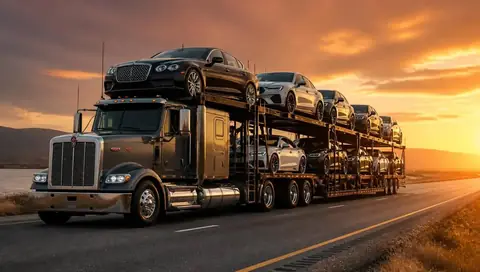
Most vehicles ride on an open 7- to 10-car carrier, secured by wheel straps rather than chains over the suspension. Enclosed transport puts the vehicle inside a hard-sided trailer with a lift gate and soft-tie straps, which is what we recommend for anything low, freshly painted or hard to replace. Which one you get depends on your preference, the lane and what is running it that week.
What we'll ask you about
- Year, make and model
- Any modifications: lift, lowering, wide body, roof rack
- Oversized tires or a camper shell
- Whether it runs, rolls, steers and brakes
- Both addresses and access
- Your date range
General guide: how vehicles usually move
A starting point, not a guarantee of equipment. Your shipment is reviewed before anything is assigned.
| What you're moving | Common transport method |
|---|---|
| Standard running car or SUV | Open carrier / enclosed by request |
| Low-clearance or exotic car | Enclosed with lift gate and soft ties |
| Classic or collector car | Enclosed / premium enclosed |
| Seized, no wheels or no brakes | Specialized equipment / rollback |
| Lifted or dually pickup | Open carrier, position-dependent / specialized |
| Motorcycle | Enclosed with chock and soft ties / open |
| Electric vehicle | Open or enclosed |
| Multiple vehicles together | Open carrier / dedicated enclosed load |
| Address a 75-foot truck cannot reach | Nearby meeting point, door-to-door otherwise |
Transportation equipment is determined based on the size, weight, condition, modifications, route and accessibility of your vehicle. The methods shown here are examples of equipment that may be used. Enterprise Auto Transport LLC will review your shipment and work with an appropriate motor carrier to determine the best available transportation option.
Tires, brakes and anything that rolls: the owner's responsibility
- Anything that rolls or tows on its own wheels - boats, RVs, campers, utility and enclosed trailers, equipment trailers - must be roadworthy before pickup. That means sound tires with tread and no dry rot, correct air pressure, working bearings and hubs, functioning brakes and lights, a good coupler, safety chains and a spare if one is available.
- Equipment that has been parked for a long season is the most common problem. Tires that look fine can be dry-rotted and years past their date code, and bearings that have not been greased will run hot. If your boat or trailer has been sitting, have the tires and bearings checked before transport.
- The customer is responsible for the cost of any repairs needed to make the unit safe to move - tires, wheels, bearings, brakes, lights, couplers or anything else that allows the unit to roll or operate.
- If a tire blows out, a bearing fails or the unit becomes disabled in transit, the customer is responsible for the cost of towing to the nearest service facility and for the parts and labor to repair it. Roadside service on the highway costs considerably more than doing the work in advance.
- Repairs made on the road can add days to the delivery window. Enterprise Auto Transport LLC is a licensed brokerage and is not responsible for the mechanical condition of the equipment, for the cost of repairs or towing, or for delays caused by them.