Enterprise Auto Transport LLC is an owner-operated, federally licensed & bonded nationwide auto transport brokerage (USDOT #2273104 / MC #774106). All logistics are managed via our central dispatch at (239) 273-4649 - this is our only phone number.
Trucking Industry News
Trump Signs Red-Dyed Diesel Executive Order: Where Can Truckers Find It?
A practical guide to red-dyed diesel suppliers, sample station addresses, and the federal and state rules truckers should verify before buying.
October 10, 2026 · 10 min read
Ready to ship your car?
Get a no-obligation quote from Enterprise Auto Transport LLC. Owner-operated, U.S.-based, and licensed with the FMCSA.
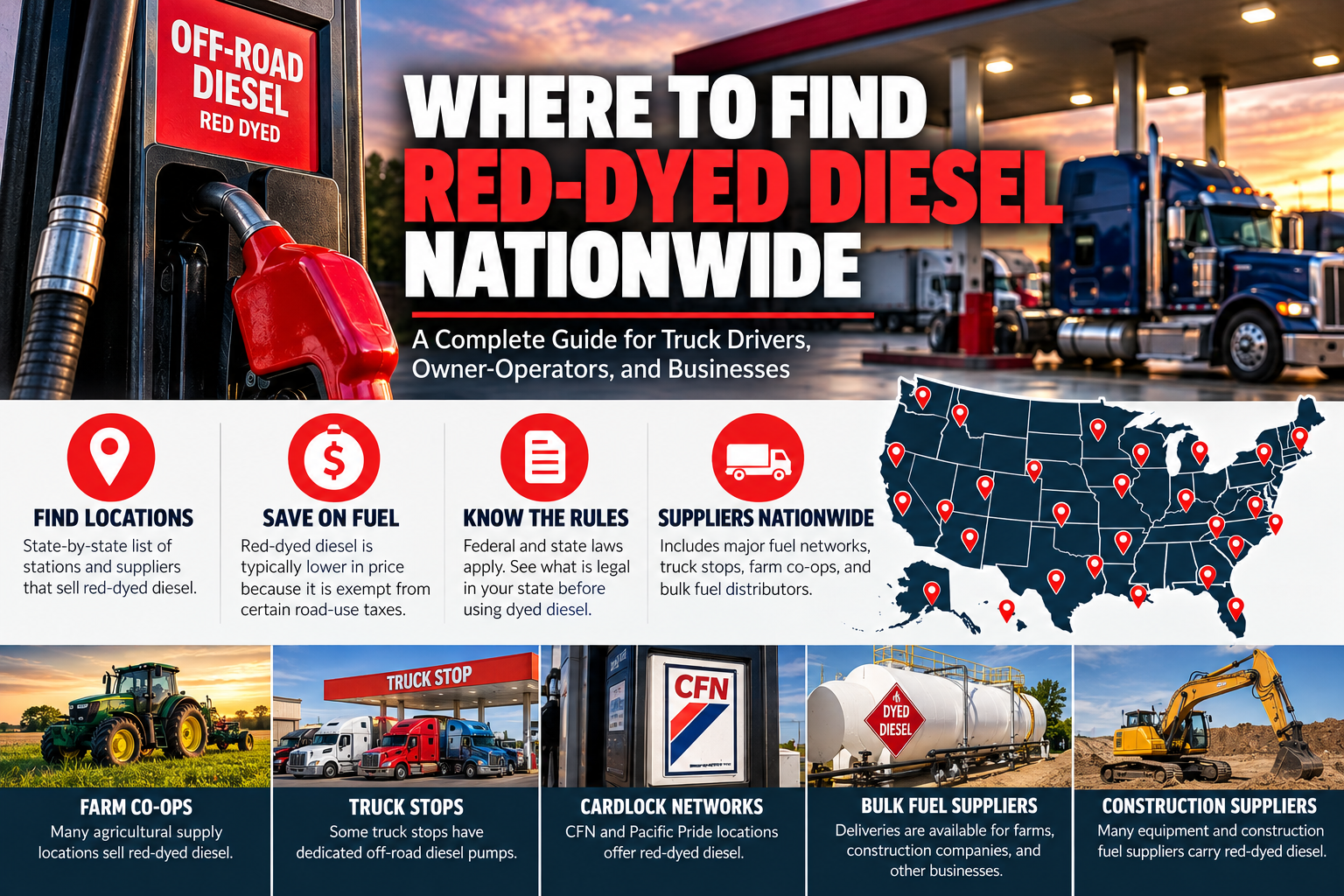
Supplied red-dyed diesel guide graphic. Locations, fuel availability, price differences and legal eligibility must be confirmed separately.
Share this article
Verify before you book
Two minutes on the FMCSA website tells you who you're really dealing with
You do not have to take any company's word for it. The Federal Motor Carrier Safety Administration keeps free public records on every licensed brokerage and carrier in the country. Here is exactly what to ask for and where to verify it:
1.Ask for the MC and USDOT numbers
Every legitimate brokerage and carrier must provide both on request. Our numbers: USDOT #2273104 and MC #774106. If a company hesitates or deflects, stop.
2.Look them up on the FMCSA SAFER system
Go to safer.fmcsa.dot.gov and use the Company Snapshot search. Enter the MC or USDOT number and confirm the legal name, operating status and “Authorized” brokerage or carrier authority match what you were told.
3.Confirm the $75,000 brokerage bond
In the FMCSA Licensing & Insurance portal (li-public.fmcsa.dot.gov), verify the brokerage's BMC-84 bond or BMC-85 trust fund is active. No active bond means no legal authority to brokerage your shipment.
4.Demand the carrier's information and payment breakdown
If a company says they have a carrier for you but never sends you the carrier's name, DOT/MC number, driver contact and truck details, or you never get to see how much of your payment is going to the carrier, that is a red flag. A legitimate brokerage discloses the assigned carrier and explains the brokerage fee before you book.
When you check our records you'll find Enterprise Auto Transport LLC, USDOT #2273104, MC #774106; an owner-operated, federally licensed and bonded brokerage based in Naples, Florida, working by phone and email with no walk-in office. You can also read our full carrier vetting process.
President Donald Trump has signed an executive order addressing diesel fuel taxes and red-dyed diesel, offering potential temporary relief to an industry struggling with high operating costs.
But as trucking industry commentator CDL Shorty pointed out in a recent LinkedIn discussion, there is a practical problem that deserves attention.
Where are truck drivers actually supposed to find red-dyed diesel?
It's a good question, especially for owner-operators driving large commercial trucks across the country.
At Enterprise Auto Transport, we decided to do some research and put together a nationwide resource listing red-dyed diesel suppliers, commercial fueling networks, and actual station addresses.
Because announcing fuel relief is one thing. Helping drivers figure out where to obtain the fuel is another.
What Did President Trump Sign?
Temporary relief remains subject to Treasury and IRS implementation and applicable state rules. Tax deferral is not tax forgiveness.
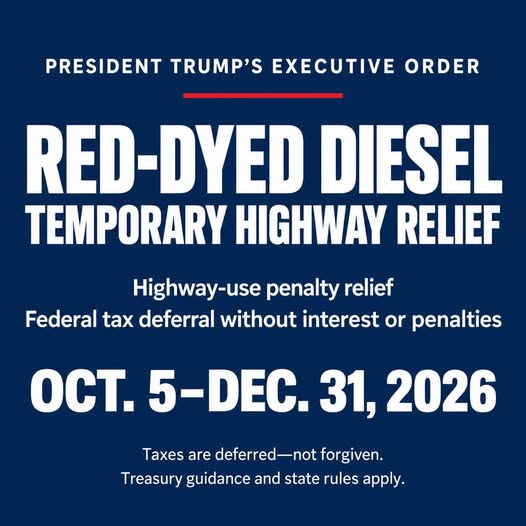
On October 5, 2026, President Donald Trump signed Executive Order 14435, Emergency Tax Relief on Diesel Fuel.
Section 2(a) directs Treasury to determine whether specified relief is authorized under 26 U.S.C. 7508A and, if so, defer certain tax payments incurred from October 5 through December 31, 2026. Deferring a payment is not the same as forgiving the tax; section 4 separately directs Treasury to explore ways to eliminate deferred amounts.
Section 2(c) directs Treasury, within five days, to have the IRS announce relief from specified dyed-diesel highway-use penalties for that period. Section 3 requires implementing guidance identifying the relief, conditions, covered taxpayers and payment deadlines.
The order is not a blanket assurance that every truck can use red-dyed diesel without tax or legal consequences. Check the applicable IRS implementation and state fuel-tax rules before buying fuel for highway use. The order also calls for engagement with states and continued transportation safety enforcement.
CDL Shorty Raises the Question Truckers Are Asking
In a LinkedIn video discussing the executive order, CDL Shorty highlighted some of the practical challenges facing drivers who might want to use red-dyed diesel.
Most interstate truck drivers fuel at large truck stops designed to accommodate tractor-trailers.
But red-dyed diesel is more commonly sold through agricultural cooperatives, farm supply locations, commercial cardlock stations, and bulk fuel distributors.
That creates several questions:
These are important considerations for an industry where time, fuel consumption, and operating costs directly affect profitability.
CDL Shorty's discussion also raised the question of why policymakers wouldn't simply reduce taxes on ordinary highway diesel instead.
That alternative would have its own legal and legislative requirements, but it highlights the difference between announcing relief and making it easy for drivers to use.
Where are the red-dyed diesel pumps?
Can a tractor-trailer physically access the station?
Does the supplier accept commercial fleet fuel cards?
Is the fuel available for immediate purchase or only bulk delivery?
What happens when a driver crosses into another state?
We Went Looking for Red-Dyed Diesel Suppliers Nationwide
To help answer the availability question, we reviewed P-Fleet’s published CFN Dyed Diesel Listings By State & City directory and the supplier resources linked below. Red-dyed diesel is also commonly called off-road diesel.
The sample addresses below come from published supplier listings, not live inventory checks or confirmation that a highway vehicle is eligible to use the fuel. The directory may contain abbreviated addresses, and we have not established its update date. Confirm the full address, product availability, account requirements and tractor-trailer access directly before traveling.
Red-Dyed Diesel Stations by State
The following five states are sample listings, not a complete nationwide directory. Use the linked P-Fleet PDF and supplier locators for additional states, and confirm each location directly.
Alabama
Alabama
City
Address
Dothan
4279 Montgomery Highway
Elberta
13320 Main Street
Grand Bay
12640 Highway 188
Gulf Shores
2105 East 2nd Street
Huntsville
3464 Highway 53
Madison
3490 Wall Triana Highway
Oxford
1808 Highway 78 East
Tuscaloosa
5200 Kauloosa Avenue
Arizona
Arizona
City
Address
Apache Junction
2475 South Delaware Drive
Chandler
11320 East Germann Road
Mesa
1850 South Solomon
Phoenix
5821 West Buckeye Road
Phoenix
2450 South 7th Street
Prescott Valley
6450 North Viewpoint Drive
Scottsdale
13240 Scottsdale Road
Tempe
106 South Perry Lane
Tucson
2750 South Kolb Road
Yuma
490 Gila Street
California
California
City
Address
Anaheim
1436 West Santa Ana Street
Antioch
3050 Wilbur Avenue
Atwater
2249 Atwater Boulevard
Bakersfield
9741 South Enos Lane
Barstow
2370 West Main Street
Oregon
Oregon
City
Address
Fairview
20116 NE Sandy Boulevard
Cornelius
601 East Baseline
Tualatin
18955 SW Teton Avenue
Canby
640 SW 2nd Avenue
Dallas
185 West Ellendale Avenue
Estacada
453 SW 2nd Avenue
Salem
810 Lancaster Drive SE
Stayton
2010 West Washington Street
Woodburn
2221 North Pacific Highway
Washington
For locations in additional states, use the complete CFN directory linked below.
Red-dyed diesel is generally diesel fuel marked with red dye to identify it for specific tax treatment.
It is commonly used in agricultural equipment, construction machinery, industrial generators, and other qualifying off-road applications.
Because certain road-use fuel taxes are not collected on qualifying sales, it may cost less than regular highway diesel.
But the price difference does not eliminate the legal restrictions associated with its use.
Under ordinary federal rules, using untaxed dyed diesel in registered highway vehicles is generally prohibited unless a legal exception applies.
Which Taxes Are Federal, Which Are State — and Who Checks Your Tank
A common point of confusion is which level of government is actually behind the price difference between clear and dyed diesel.
The only diesel fuel tax that is regulated and collected by the federal government is the federal excise tax on clear diesel, currently 24.4 cents per gallon.
The road taxes that are applied to clear diesel — and are not collected on dyed diesel — are state taxes. They are collected and governed by each individual state, not by the federal government. That distinction matters when a driver crosses state lines, because the tax picture changes with every border.
Enforcement is mostly local, too. The people who run the scale houses — the weigh stations commercial trucks pass through — are state workers, and checking whether a vehicle is running dyed diesel is part of what they can do. Fuel tank checks are a recognized inspection method, and using dyed diesel in a highway vehicle carries penalties under ordinary federal rules. That is worth remembering before anyone treats temporary relief as a green light.
The penalties in Washington illustrate the scale of the risk. A person with dyed fuel in the supply tank of a licensed vehicle faces a civil penalty of $10 for each gallon of dyed fuel, or $1,000, whichever is greater. So a 100-gallon fill puts the penalty at $1,000, and a 1,000-gallon amount reaches $10,000. Bulk storage maintained for an illegal use is penalized the same way, and the state can base its assessment on the storage tank's capacity. Penalties also repeat: if a violation has been assessed within the previous five years, the amount is multiplied by the number of prior violations plus one.
Federal law adds its own exposure on top of state penalties, so the total cost of a tank check can exceed the state number. Confirm the current penalty rules with official guidance rather than relying on any single figure in this article.
State tax treatment of dyed diesel varies. In Washington, for example, retail sales tax applies to sales of dyed diesel, while clear diesel is sold without retail sales tax because its state fuel taxes are already included in the pump price.
Exemptions narrow the gap in specific cases. In Washington, diesel bought for agricultural purposes by a qualifying farm fuel user can be exempt from sales tax with the proper exemption certificate, and exemptions also exist for uses such as manufacturing and resale.
The practical result in that state: the difference between a gallon of clear diesel and a gallon of dyed diesel works out to roughly 30 cents per gallon, depending on the sales tax rate where you buy.
That figure is one state's example, not a national rule. The gap changes with state and local tax rates, so confirm current rates with the state revenue agency and your fuel supplier.
Which States Have Suspended Their Own Dyed Diesel Rules
The federal order does not rewrite state law. Each state decided for itself, and by October 9, 2026, seventeen states had taken some form of action. The list below records what each state actually did and how long it lasts, based on the governor's office, state revenue department or the notice filed with the International Fuel Tax Association.
Read the wording carefully before acting on any of them. "Suspension" covers three quite different things: a waiver of state penalties, a pause in enforcement priorities, and an actual suspension of the tax. They do not all mean the same thing at the pump or at a weigh station.
Which States Have Suspended Their Own Dyed Diesel Rules
State
What the state did
Window
Alabama
Governor directed the state law enforcement agency to halt dyed diesel enforcement for agriculture and timber
120 days from Sept 24, 2026
Arkansas
Emergency order suspended motor-fuel restrictions and penalties for farmers and loggers
Sept 30 to Oct 30, 2026
Georgia
Revenue department waived state penalties for selling, delivering or consuming dyed diesel in on-road vehicles
Oct 6 to Nov 5, 2026
Illinois
Executive order directs the revenue department and state police to allow on-road use of agricultural dyed diesel
Effective Oct 6, 2026
Indiana
Executive order suspends the special-fuel restriction for farmers and timber harvesters
Through Nov 4, 2026
Iowa
Proclamation suspends state penalties for vehicles hauling named farm products on public roads
Through Feb 2, 2027
Kentucky
Emergency order suspends specified restrictions on public-road use and related state penalties
Effective Oct 8, 2026
Louisiana
Order suspends restrictions and state penalties for specified vehicle registration classes
Sept 23 to Oct 22, 2026
Maryland
Emergency order allows dyed diesel in on-road vehicles engaged in agricultural and forestry hauling
30 days from Oct 9, 2026, renewable
Missouri
Order allows agricultural use of dyed diesel and raises the livestock hauling weight limit
Sept 30 to Oct 30, 2026
Nebraska
Order suspends specified dyed-fuel penalties and opens a targeted refund route
90 days from Sept 24, 2026
North Carolina
Revenue department directed to provide penalty relief from the highway-use prohibition
Through Dec 31, 2026
North Dakota
Order suspends dyed-fuel restrictions and administrative fees for specified agricultural activities
Sept 29 to Nov 30, 2026
Oklahoma
Governor asked the tax commission, state police and corporation commission to pause enforcement on farm vehicles
120 days from Sept 28, 2026
South Dakota
Governor directed the Department of Public Safety to adjust enforcement priorities
While the federal order is in effect
Tennessee
Revenue department suspended enforcement for agricultural and forestry operations
Through Oct 31, 2026
Texas
Disaster proclamation suspends state restrictions and penalties on dyed diesel on Texas roads
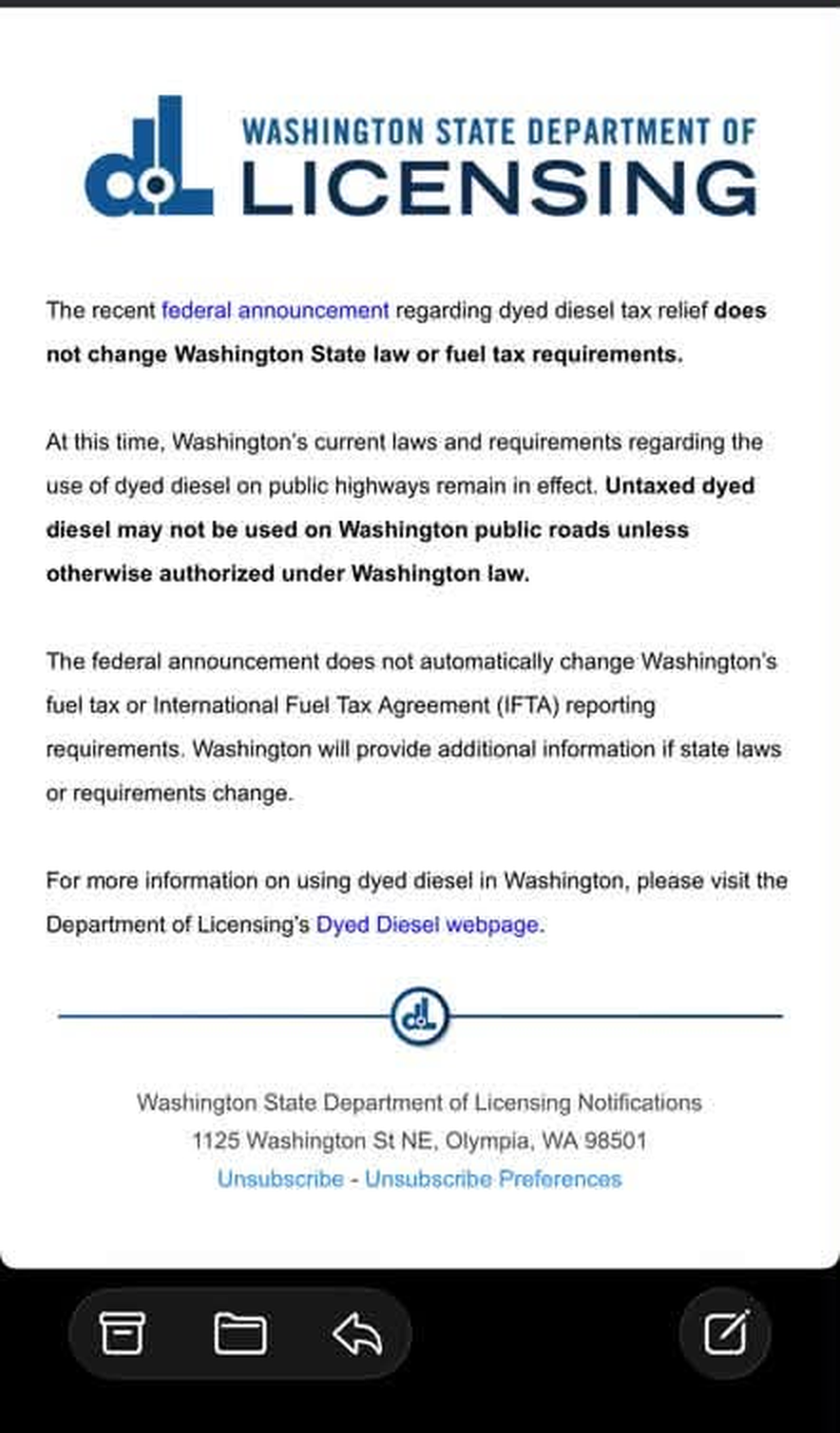
The warning Washington State Department of Licensing sent to license holders: the federal announcement does not change Washington state law or fuel tax requirements. Recipient details removed.
The other half of the map matters more than the first half, because that is where drivers get caught. Several states have said plainly that the federal order changed nothing inside their borders.
Kansas is the clearest example of why a governor's signature is not always enough. The prohibition sits in state statute rather than an administrative rule, so the governor cannot waive it and only the legislature can change it - and the legislature is not in session until after the federal relief period ends on December 31, 2026.
Minnesota's revenue department says it does not have the authority to suspend the state's fuel taxes, so any change there would require legislative action. Ohio suspended its motor-fuel tax down to a fraction of a cent through January 2, 2027, yet agricultural organizations were still asking the governor in early October to lift the separate dyed-diesel restriction.
South Dakota shows the other kind of limit. The governor can direct enforcement priorities, but the state cannot waive taxes set in law, so the revenue department clarified that only agricultural producers holding a valid exemption certificate should be fuelling with dyed diesel on the road, and that sales tax still applies to everyone else.
Warning: a state that has not acted is a state where the old penalties still apply. The federal order pauses federal penalties; it does not pause state ones.
Warning: relief is usually narrower than the headline. Most orders cover named products, named vehicle classes or named operations, not every truck on the road.
Warning: these orders expire on different dates, several before December 31. A tank filled under one state's waiver can still be a violation the next day or across the next border.
Warning: tax relief and penalty relief are separate. In Texas the state's 20-cent-per-gallon motor-fuel tax was not waived, and in South Dakota and Georgia state or local sales taxes still apply.
The States That Did Not Change Anything
State
Where the rules still stand, as of October 9, 2026
California
The state has not waived enforcement. Dyed diesel in a highway tank remains prohibited on public highways except in limited cases.
Kansas
A statute, not a rule, bars dyed diesel in a vehicle's supply tank. The governor cannot waive it, and the legislature is out of session until January 2027.
Minnesota
The revenue department states the federal order does not change state law or the taxes that apply. It says it cannot suspend them.
Montana
The state transportation department confirmed the statutory ban on dyed diesel on public roads remains in effect.
Ohio
The fuel-tax holiday is in place, but the dyed-diesel restriction was still being requested, not lifted, as of October 9, 2026.
Washington
The Department of Licensing notified license holders that the federal announcement does not change state law or fuel tax requirements.
Drivers should not treat the executive order, a supplier listing or this article as authorization to use dyed diesel in a highway vehicle. Federal relief and state fuel-tax rules must be checked separately.
Before purchasing, verify the following with official guidance and the supplier. This article does not establish your eligibility for any tax or penalty relief.
Whether federal relief applies to their particular use.
Whether the states they operate in permit that use.
Whether any additional taxes or reporting requirements apply.
Whether the station accommodates their truck and trailer.
Whether their fuel card is accepted.
Whether the diesel meets their engine manufacturer's specifications.
At Enterprise Auto Transport, we work with carriers who move vehicles throughout the United States.
Fuel is a significant expense for these businesses.
When a car hauler transports vehicles from Minnesota to Florida, the carrier must account for diesel, tolls, insurance, maintenance, driver compensation, and the cost of operating specialized equipment.
Many independent carriers are already working with narrow margins.
Changes in diesel costs can influence which loads carriers accept and what rates they need to operate profitably.
That's why discussions about fuel relief matter to the auto transport industry.
But CDL Shorty's question is worth repeating:
If truckers are being offered temporary relief through red-dyed diesel, how are they supposed to find the fuel?
And equally important, how can they use it legally across state lines?
Those questions need clear answers.
Help Us Build a Better Nationwide Directory
We're continuing to collect information about red-dyed diesel locations across the United States.
If you operate a fuel station, farm cooperative, truck stop, or commercial fueling facility that sells red-dyed diesel, we'd welcome additional location information.
We're particularly interested in suppliers offering:
Our goal is to make this directory useful for truck drivers, farmers, contractors, and businesses looking for legitimate fuel suppliers.
Red-dyed diesel directly at the pump
Access for tractor-trailers
Commercial fleet fuel-card acceptance
Public purchasing options
Clearly posted hours and product availability
Frequently asked questions
These answers are general guidance, not confirmation of tax eligibility or fuel availability.
Did President Trump make red-dyed diesel legal for all truckers?
No blanket nationwide authorization should be assumed. The executive order addresses specified federal relief, while state rules and implementation requirements remain important.
Which states allow dyed diesel on the road right now?
As of October 9, 2026, seventeen states had suspended state penalties, paused enforcement or limited the restriction to named agricultural uses. Several other states, including California, Kansas, Minnesota, Montana, Ohio and Washington, said the federal order changed nothing for them.
The two state tables above list each action and its expiry date. Check the linked state notice before filling up, because these orders were written quickly, apply to specific operations and products, and expire on different dates.
Where can I find red-dyed diesel near me?
Start with the CFN and Pacific Pride station locators or contact agricultural fuel suppliers and local commercial fuel distributors.
Can a semi-truck pull into a red-dyed diesel station?
Some commercial fueling stations can accommodate large trucks, but many agricultural and smaller retail locations cannot. Verify access before arriving.
Will truck stops begin selling red-dyed diesel?
That depends on individual fuel retailers and their distribution arrangements. The executive order does not guarantee that major truck-stop chains will add dedicated dyed-diesel pumps.
How long is the temporary federal relief expected to last?
Section 2 identifies October 5 through December 31, 2026 for the specified relief, subject to implementing guidance and legal conditions. Deferred taxes are not automatically forgiven.
Does red-dyed diesel damage truck engines?
The red dye itself is not generally the issue. The fuel must meet the engine manufacturer's specifications and applicable emissions-system requirements.
About Enterprise Auto Transport
Enterprise Auto Transport LLC is a licensed auto transport brokerage coordinating open and enclosed vehicle shipping throughout the United States.
We specialize in carrier verification, transportation safety, and seasonal vehicle shipping, including routes between Minnesota, the Midwest, and Southwest Florida.
We believe the trucking industry benefits when carriers, brokerages, and customers have access to accurate information about operating costs, safety, and regulatory developments.
Related resources:
Disclaimer: This article is provided for general informational purposes. Supplier listings may change, and Enterprise Auto Transport does not independently guarantee fuel availability or legal eligibility. Consult official federal and state guidance before using dyed diesel in highway vehicles.
When a giant brokerage advertises “access to a network of over 30,000 carriers,” it sounds like a private corporate fleet. In reality, nearly every licensed auto transport brokerage in America has access to those exact same carriers - because they are all posting to the same public load board. Here is how the industry actually works, and what to look for instead of network size.
Operation Highway Shield put more than 3,300 commercial vehicles under inspection, took 766 unsafe drivers and vehicles off the road, and recovered nearly $1 million in stolen cargo. Here is why this enforcement effort matters for honest brokerages, carriers, and customers.