Enterprise Auto Transport LLC is an owner-operated, federally licensed & bonded nationwide auto transport brokerage (USDOT #2273104 / MC #774106). All logistics are managed via our central dispatch at (239) 273-4649 - this is our only phone number.
Fraud Prevention
Auto Transport Warning: Why a Taped Paper DOT Sign on a Truck Should Be a Red Flag
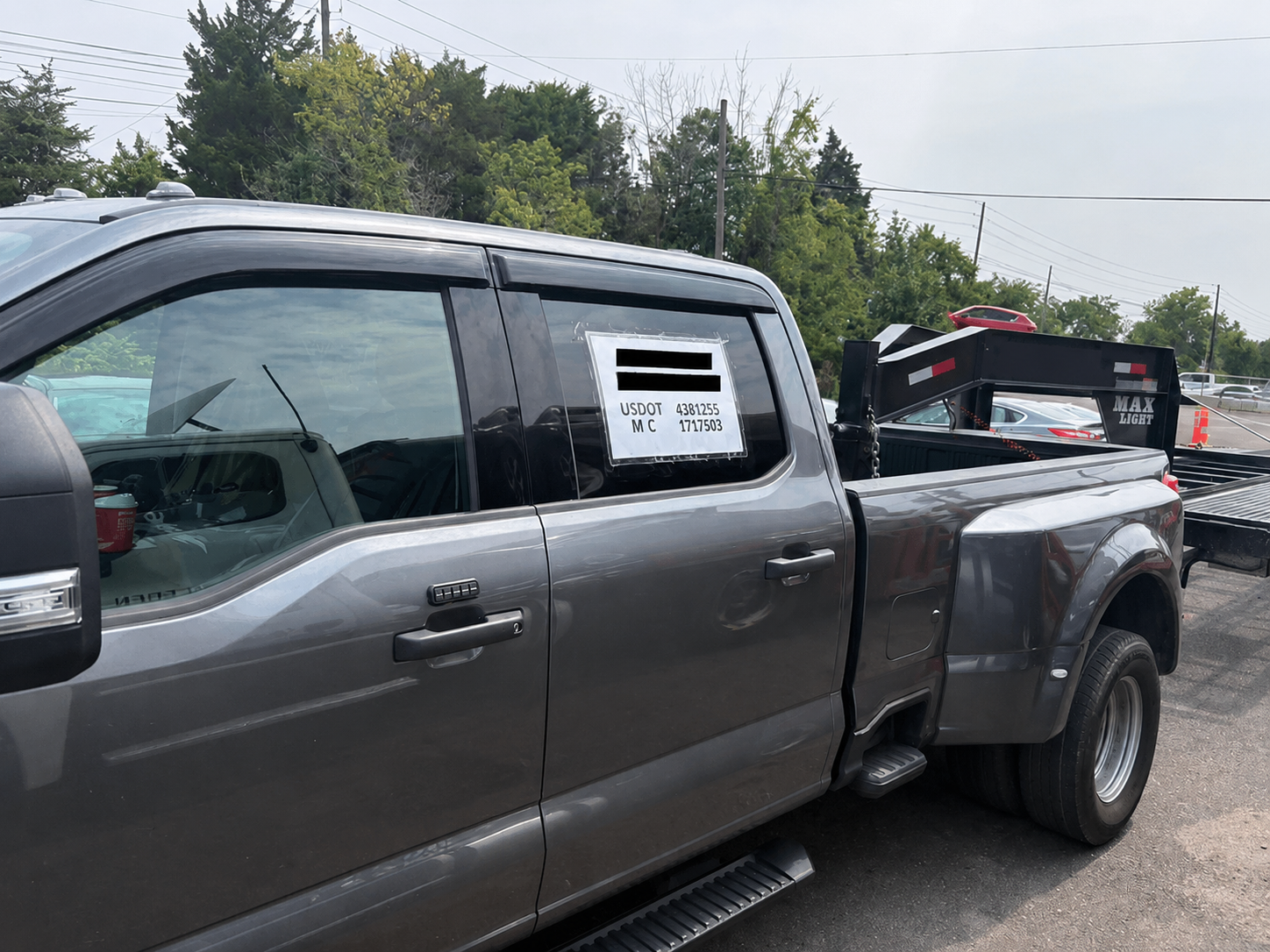
Most customers assume the truck that arrives is the carrier their brokerage hired. That is no longer a safe assumption. A paper sign taped to the window displaying a company name and USDOT number is a red flag that deserves verification before your vehicle is loaded.
September 3, 2026 · 8 min read
Ready to ship your car?
Get a no-obligation quote from Enterprise Auto Transport LLC. Owner-operated, U.S.-based, and licensed with the FMCSA.
A paper sign taped to a window is not a legal display of operating authority. Legitimate carriers permanently letter their USDOT and MC numbers on both sides of the cab.
Share this article
Verify before you book
Two minutes on the FMCSA website tells you who you're really dealing with
You do not have to take any company's word for it. The Federal Motor Carrier Safety Administration keeps free public records on every licensed brokerage and carrier in the country. Here is exactly what to ask for and where to verify it:
1.Ask for the MC and USDOT numbers
Every legitimate brokerage and carrier must provide both on request. Our numbers: USDOT #2273104 and MC #774106. If a company hesitates or deflects, stop.
2.Look them up on the FMCSA SAFER system
Go to safer.fmcsa.dot.gov and use the Company Snapshot search. Enter the MC or USDOT number and confirm the legal name, operating status and “Authorized” brokerage or carrier authority match what you were told.
3.Confirm the $75,000 brokerage bond
In the FMCSA Licensing & Insurance portal (li-public.fmcsa.dot.gov), verify the brokerage's BMC-84 bond or BMC-85 trust fund is active. No active bond means no legal authority to brokerage your shipment.
4.Demand the carrier's information and payment breakdown
If a company says they have a carrier for you but never sends you the carrier's name, DOT/MC number, driver contact and truck details, or you never get to see how much of your payment is going to the carrier, that is a red flag. A legitimate brokerage discloses the assigned carrier and explains the brokerage fee before you book.
When you check our records you'll find Enterprise Auto Transport LLC, USDOT #2273104, MC #774106; an owner-operated, federally licensed and bonded brokerage based in Naples, Florida, working by phone and email with no walk-in office. You can also read our full carrier vetting process.
Do not assume the truck is the carrier your brokerage hired
Most customers assume that if a truck arrives to pick up their vehicle, it must be the same carrier their brokerage hired. Unfortunately, that is not something you should assume anymore.
One of the red flags we are watching closely in auto transport is a truck arriving with a temporary piece of paper taped to the window displaying a company name and USDOT number.
A taped sign does not, by itself, prove wrongdoing. There can be legitimate explanations for temporary markings. Still, verify the carrier before your vehicle is loaded.
Why would a truck have a different company name or DOT number?
Here is where things can become complicated. Imagine your brokerage tells you that your assigned carrier is ABC Auto Transport - USDOT 123456. Your brokerage researched ABC Auto Transport, checked its federal operating status, reviewed its safety history, verified insurance, and dispatched your vehicle to that company.
Then a truck arrives at your house. Instead of ABC Auto Transport / USDOT 123456, you see another company name or another USDOT number - perhaps printed on a piece of paper taped to the window.
Stop. Do not release the vehicle yet. Call your brokerage and let them investigate. There may be a legitimate explanation, such as a lawful equipment-leasing arrangement. But there may also be a serious problem.
The 'clean carrier' and 'burner DOT' scheme being discussed in the industry
Transportation professionals have reported an alleged scheme in which companies operate using multiple carrier identities. The basic concept is this: one carrier maintains a relatively clean-looking operating history and uses that company to obtain loads from brokerages. But the truck actually transporting the vehicle may operate under another DOT number.
Why would someone allegedly do this? Because roadside inspections, violations, out-of-service events and other safety information can affect a motor carrier's record. Industry participants sometimes refer to DOT numbers allegedly used and replaced in this manner as 'burner DOTs.' That is industry slang, not an official FMCSA classification.
The concern is that a company could potentially keep the carrier used to obtain loads looking clean while another operating identity accumulates the negative safety history. That is exactly why looking at an MC number on a computer screen is no longer enough for us.
There is another serious issue: insurance
Suppose your brokerage verifies that ABC Auto Transport has insurance. That is important - but we want to go further. What truck is actually transporting your $40,000, $80,000 or $150,000 vehicle? Who owns it? Who operates it? What USDOT number is displayed? Who is the driver? Under whose authority is the transportation actually being performed? And most importantly: is the actual operation properly insured?
A certificate associated with one company should not cause everyone to stop asking questions when a different company or operating identity appears at pickup.
A different DOT number does not automatically mean fraud
This distinction is extremely important. There are legitimate leasing and other transportation arrangements in the trucking industry. Therefore, we are not telling consumers that every truck with temporary markings, every leased truck, or every DOT discrepancy is automatically fraudulent.
We are saying it needs to be verified. There is an enormous difference between a documented, legitimate arrangement that can be explained and verified and a customer unexpectedly discovering that a completely different carrier has arrived to take possession of their vehicle. We aren't going to guess which one it is. We're going to verify it.
If you see a taped paper sign, take a picture
If you are an Enterprise Auto Transport LLC customer and a truck arrives with a company name or USDOT number printed on paper and taped to the window, please take a photograph and contact us before releasing your vehicle.
Also contact us immediately if the company name or USDOT number on the truck does not match the carrier information we provided to you. Do not argue with the driver. Do not accuse the driver of committing fraud. Simply tell the driver that your brokerage needs to verify the carrier before the vehicle can be released. We will handle the verification.
Our customers are part of the final verification
Technology can verify a tremendous amount before dispatch. But there is one thing a computer hundreds of miles away cannot see: the truck actually standing in your driveway. That is why the customer can become the final link in the verification process.
Before releasing your vehicle, look at the truck. If something doesn't match, tell us. A photograph of the truck, DOT markings and license plate can help us compare what actually arrived against the carrier we approved.
This is why we are changing carrier verification
Traditional carrier vetting often focuses heavily on the carrier's MC/USDOT number, authority status, insurance information and safety record. Those checks remain important. But we believe modern carrier verification needs to connect the entire chain: carrier → USDOT number → driver → truck → license plate → equipment/lease relationship → insurance → Bill of Lading.
If one part of that chain unexpectedly changes, we want to know before your vehicle gets on the truck - not after something goes wrong.
Remember this one rule
If the carrier we told you was coming is not the carrier that appears to be standing in your driveway, do not release your vehicle until we verify the discrepancy.
And if you see a company name and DOT number printed on a piece of paper and taped to the truck window, consider it a red flag and call us. It may have a legitimate explanation. But when someone is about to take possession of one of your most valuable assets and transport it hundreds or thousands of miles, verification is worth the extra few minutes.
Key takeaways
A paper sign taped to a truck window displaying a USDOT number is a red flag, not proof of fraud, and should be verified before loading.
Your brokerage may have approved one carrier, but a different company name or DOT number on the arriving truck requires investigation.
Legitimate leasing arrangements exist, so a discrepancy does not automatically mean fraud - but it must be explained and documented.
Take photos of the truck, DOT markings, license plate and driver documents, then contact your brokerage before releasing the vehicle.
Enterprise Auto Transport LLC verifies the full chain - carrier, DOT number, driver, truck, license plate, lease relationship, insurance and Bill of Lading.
Scammers are cloning real dealership websites and advertising vehicles they do not own. Learn how to spot a spoofed dealer site before you wire a deposit for a car that does not exist.
Most auto transport fraud solutions focus on carrier vetting. The real gap is identity: proving the person picking up your car is authorized to take it.
Before submitting a quote request, check the website address, business name and federal registration so you know which company will receive your information.