Enterprise Auto Transport LLC is an owner-operated, federally licensed & bonded nationwide auto transport brokerage (USDOT #2273104 / MC #774106). All logistics are managed via our central dispatch at (239) 273-4649 - this is our only phone number.
Fraud Prevention
Why Enterprise Auto Transport Is Calling for Federal Registration of Auto Transport Sales Agents
Enterprise Auto Transport LLC proposes individual sales-agent registration, identity checks and verified brokerage affiliations to protect consumers.
October 11, 2026 · 6 min read
Ready to ship your car?
Get a no-obligation quote from Enterprise Auto Transport LLC. Owner-operated, U.S.-based, and licensed with the FMCSA.
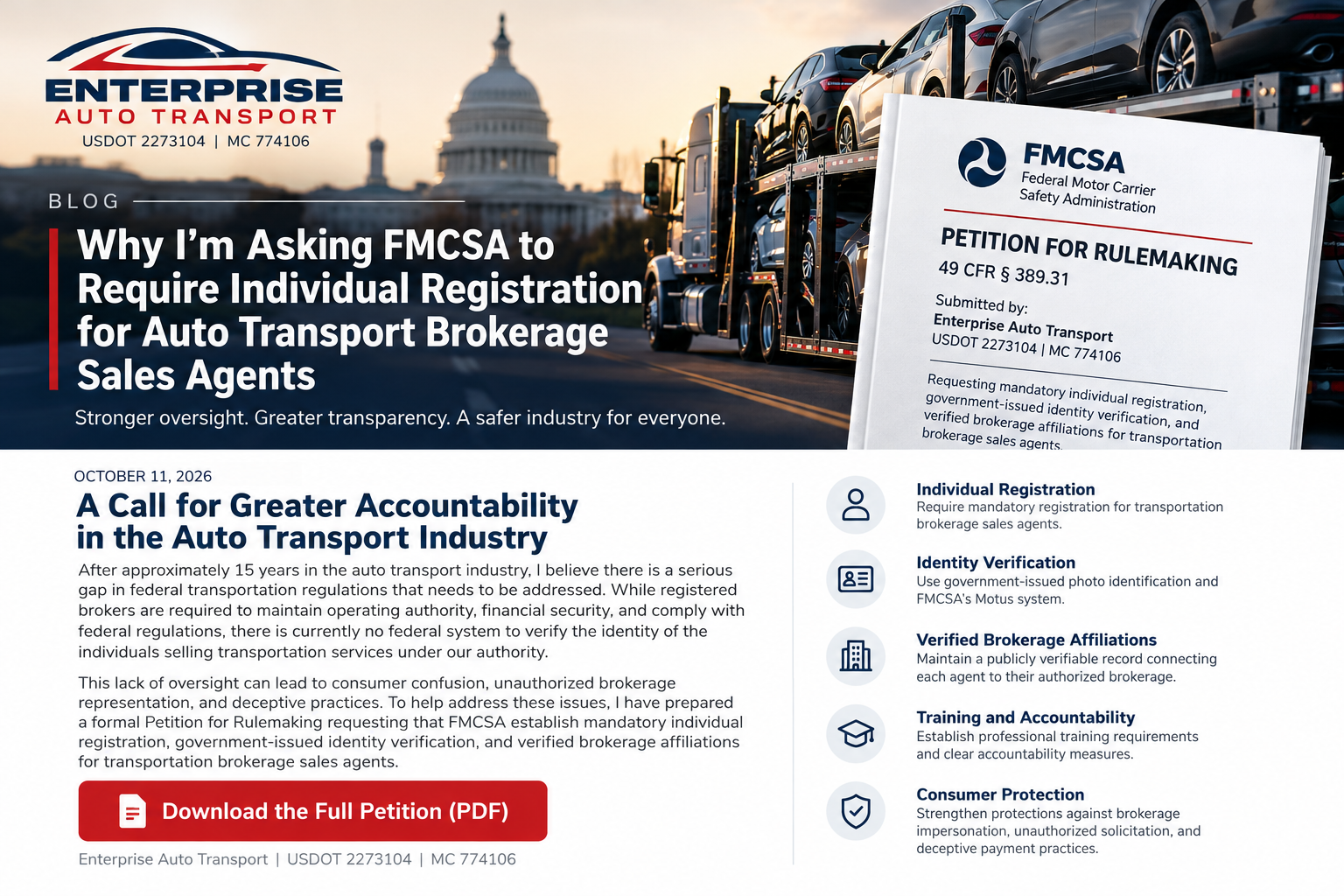
Enterprise Auto Transport's proposed reforms, dated October 11, 2026. The pictured download button is part of the graphic, not a document link. These are proposed reforms, not adopted FMCSA requirements or an agency endorsement.
Share this article
Verify before you book
Two minutes on the FMCSA website tells you who you're really dealing with
You do not have to take any company's word for it. The Federal Motor Carrier Safety Administration keeps free public records on every licensed brokerage and carrier in the country. Here is exactly what to ask for and where to verify it:
1.Ask for the MC and USDOT numbers
Every legitimate brokerage and carrier must provide both on request. Our numbers: USDOT #2273104 and MC #774106. If a company hesitates or deflects, stop.
2.Look them up on the FMCSA SAFER system
Go to safer.fmcsa.dot.gov and use the Company Snapshot search. Enter the MC or USDOT number and confirm the legal name, operating status and “Authorized” brokerage or carrier authority match what you were told.
3.Confirm the $75,000 brokerage bond
In the FMCSA Licensing & Insurance portal (li-public.fmcsa.dot.gov), verify the brokerage's BMC-84 bond or BMC-85 trust fund is active. No active bond means no legal authority to brokerage your shipment.
4.Demand the carrier's information and payment breakdown
If a company says they have a carrier for you but never sends you the carrier's name, DOT/MC number, driver contact and truck details, or you never get to see how much of your payment is going to the carrier, that is a red flag. A legitimate brokerage discloses the assigned carrier and explains the brokerage fee before you book.
When you check our records you'll find Enterprise Auto Transport LLC, USDOT #2273104, MC #774106; an owner-operated, federally licensed and bonded brokerage based in Naples, Florida, working by phone and email with no walk-in office. You can also read our full carrier vetting process.
Enterprise Auto Transport LLC is calling for proposed FMCSA reforms requiring identity verification, verified brokerage affiliations, and greater accountability for individuals selling vehicle transportation services.
Since 2012, Enterprise Auto Transport LLC has worked in an industry where trust is essential. Customers entrust transportation companies with valuable vehicles, personal information, residential addresses, and often deposits before their vehicles are ever picked up.
Federally registered auto transport brokers must comply with federal operating authority and financial responsibility requirements.
But there is a significant question that deserves greater attention:
Who is verifying the individuals actually selling transportation services under those federal brokerage authorities?
Enterprise Auto Transport has prepared a formal Petition for Rulemaking asking the Federal Motor Carrier Safety Administration (FMCSA) to consider mandatory individual registration, identity verification, and verified brokerage affiliations for transportation sales agents.
The Problem: A Legitimate MC Number Does Not Verify the Salesperson
Consumers are frequently advised to verify an auto transport company's USDOT and MC numbers before booking a shipment.
That is important, but it does not tell the entire story.
A legitimate federal brokerage registration does not necessarily mean that the person answering a telephone call, advertising on social media, or requesting a deposit is authorized to represent that brokerage.
Someone may claim to work for a registered transportation company without the company's permission.
A consumer may see a legitimate business name or MC number and assume the person contacting them has been properly authorized.
Currently, there is no comprehensive federal individual registration system allowing consumers to verify a transportation salesperson's identity and current brokerage affiliation.
We believe that needs to change.
Why We Are Raising This Issue
Our company has encountered concerns involving individuals allegedly claiming to represent Enterprise Auto Transport without authorization.
In one situation, an unrelated individual acquired a domain name resembling our company's website. Our concern is not the domain registration itself, but reports that the individual has represented themselves to callers as Enterprise Auto Transport despite having no authorized relationship with our brokerage.
In another incident, a customer reported contacting a different transportation company through a Google advertisement and being told by a sales representative that the owner of Enterprise Auto Transport worked there and would contact the customer later.
The customer recognized that something was wrong and ended the call without booking or paying.
We describe these as reported incidents, not adjudicated findings of misconduct.
They illustrate a broader concern: consumers need a reliable way to distinguish an authorized transportation representative from someone merely claiming to represent a legitimate business.
Social Media and Third-Party Transportation Sales
We are also asking FMCSA to examine the growing use of social media platforms, including Facebook Marketplace, to solicit auto transport customers.
One area of concern involves individuals, including those operating overseas, who advertise transportation services, obtain customer orders, and then arrange for other brokerages to post those vehicles on transportation load boards.
Not every third-party sales arrangement is improper, and operating outside the United States does not itself indicate fraud.
However, these arrangements raise questions that deserve regulatory attention.
Who is actually selling the transportation service? Which brokerage authorized that individual? Who is collecting the deposit? Has the customer been told which federally registered brokerage is responsible? Who is accountable if the transaction goes wrong?
We believe consumers deserve clear answers before they sign an agreement or make a payment.
What We Are Asking FMCSA to Consider
Our Petition for Rulemaking proposes several consumer protection measures:
The petition also asks FMCSA to examine domestic regulatory accountability, including whether a U.S. domicile requirement or alternative protections would be legally appropriate.
Individual federal registration: Transportation sales agents conducting covered brokerage activities would obtain unique individual registration numbers.
Government-issued identification: Applicants would verify their identities through FMCSA's Motus registration system or an equivalent approved process.
Verified brokerage affiliations: A registered brokerage would electronically authorize the individuals permitted to represent it.
Public verification: Consumers could check whether a sales agent is registered and currently affiliated with the brokerage the agent claims to represent.
Professional training: Covered agents would receive training in transportation regulations, truthful advertising, consumer disclosures, payment handling, and fraud prevention.
Accountability for impersonation: FMCSA would evaluate enforceable safeguards against knowingly misrepresenting a brokerage's identity or authorization.
Transparent third-party solicitation: Brokerages would document who solicited a transportation order and disclose which registered business is responsible.
Protection of customer information: Appropriate safeguards would apply to sensitive transportation and payment details.
Why This Matters to Small Transportation Brokers
Small brokerages invest considerable time and money in compliance, carrier verification, customer communication, and fraud prevention.
At Enterprise Auto Transport, we believe those responsibilities should not stop with the registered business entity.
Individuals representing a brokerage should also be identifiable and accountable.
Our proposal does not seek to require every legitimate sales employee to establish a separate brokerage or obtain an additional $75,000 surety bond merely to work for a registered broker.
Instead, we are advocating for an individual registration and authorization system that works alongside existing federal brokerage requirements.
The goal is greater transparency without placing unreasonable burdens on legitimate small businesses.
What Consumers Can Do Today
Until any additional rules are adopted, consumers should continue taking precautions before booking vehicle transportation.
Verify the company's operating authority through FMCSA. Confirm that the telephone number and website belong to the company you intend to hire. Ask for the legal name and MC number of the brokerage responsible for the shipment.
Be cautious if a salesperson claims to represent another business, requests payment to an unrelated personal account, or cannot clearly explain who will arrange the transportation.
And remember:
A legitimate MC number does not automatically make every salesperson using that number legitimate.
About Our Petition for Rulemaking
Enterprise Auto Transport has prepared a formal petition under 49 CFR § 389.31 requesting that FMCSA evaluate individual transportation sales-agent registration, identity verification, and brokerage affiliation requirements.
Regulations.gov comment tracking number: mv3-u3ba-ivvs. The supplied submission confirmation states that the comment has been sent for agency review. It does not confirm public posting, agency acceptance of the requested reforms, or approval. Once posted, the submission can be located on Regulations.gov using this tracking number.
The petition is intended to encourage federal examination of these issues and consideration of appropriate regulatory reforms. It does not mean that FMCSA has adopted or endorsed the proposals.
These are Enterprise Auto Transport LLC’s proposals, not current registration requirements or an FMCSA endorsement. This article does not establish that FMCSA has accepted the petition or begun a rulemaking proceeding.
The auto transport industry has changed significantly. Transportation sales now take place through websites, Google advertisements, telephone calls, social media, remote representatives, and third-party marketing arrangements.
Federal consumer protections should be evaluated in light of those changes.
We believe the public should be able to verify not only the transportation brokerage, but also whether the individual conducting the transaction is authorized to represent that brokerage.
Protecting consumers begins with knowing who is actually selling the transportation service.
Enterprise Auto Transport welcomes constructive discussion from brokers, carriers, consumer advocates, and transportation compliance professionals who share an interest in strengthening accountability across the industry.
Key takeaways
Verify the brokerage’s federal authority and independently confirm that the salesperson is authorized to represent it.
Individual registration and verified brokerage affiliations are proposed reforms, not requirements adopted by FMCSA.
Reported impersonation concerns are not adjudicated findings of misconduct.
A legitimate MC number does not automatically verify every salesperson using it.
Scammers are cloning real dealership websites and advertising vehicles they do not own. Learn how to spot a spoofed dealer site before you wire a deposit for a car that does not exist.
Most auto transport fraud solutions focus on carrier vetting. The real gap is identity: proving the person picking up your car is authorized to take it.
Before submitting a quote request, check the website address, business name and federal registration so you know which company will receive your information.