Enterprise Auto Transport LLC is an owner-operated, federally licensed & bonded nationwide auto transport brokerage (USDOT #2273104 / MC #774106). All logistics are managed via our central dispatch at (239) 273-4649 - this is our only phone number.
Fraud Prevention
Why Good Auto Transport Carrier Reviews Aren't Enough: A Real Screening Example
See a real carrier-screening example and learn how Enterprise Auto Transport checks carrier authority, insurance, safety records, and driver identity.
September 29, 2026 · 6 min read · Updated October 8, 2026
Ready to ship your car?
Get a no-obligation quote from Enterprise Auto Transport LLC. Owner-operated, U.S.-based, and licensed with the FMCSA.
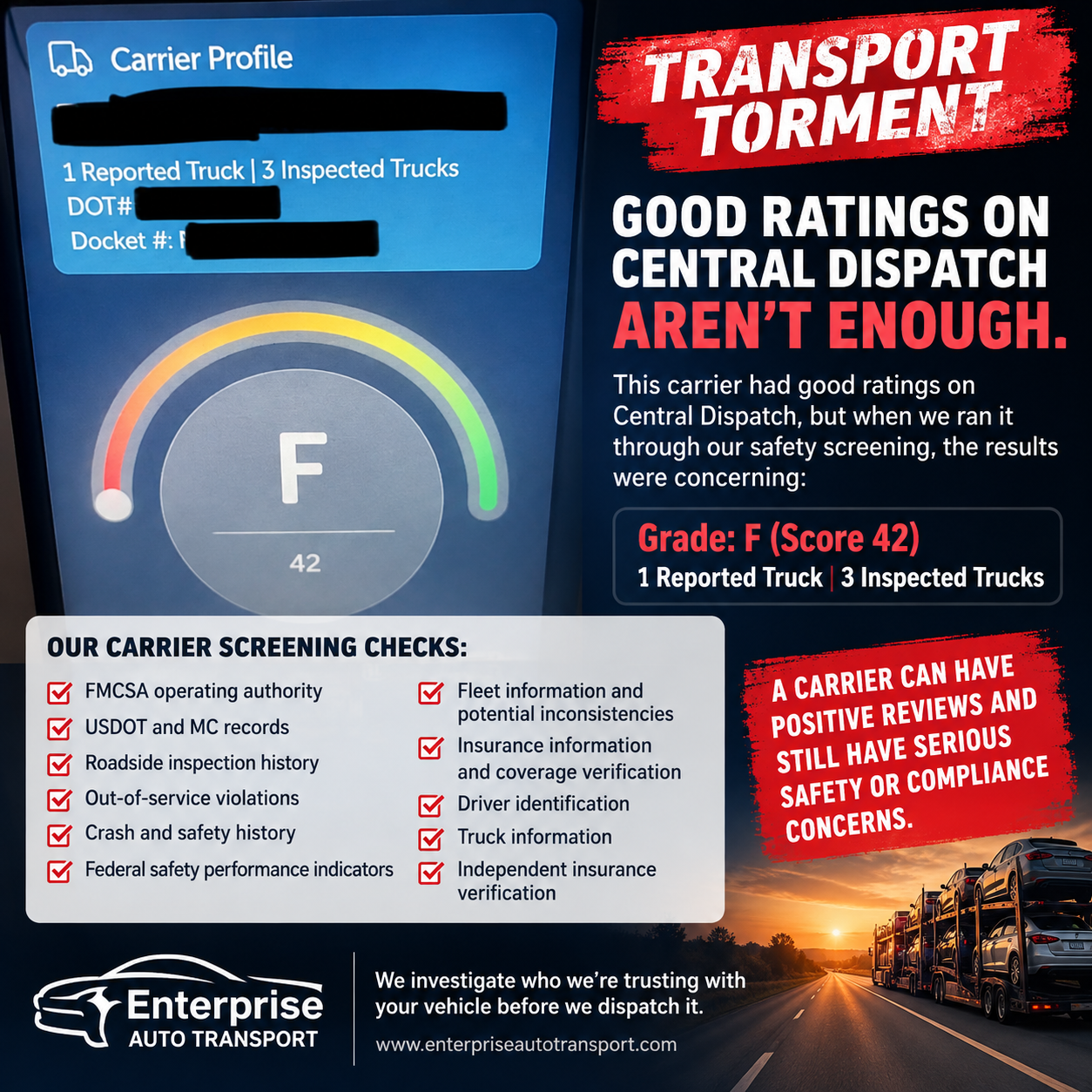
Supplied Transport Torment graphic containing a redacted screening excerpt. The third-party grade shown is not an official FMCSA safety rating.
Share this article
Verify before you book
Two minutes on the FMCSA website tells you who you're really dealing with
You do not have to take any company's word for it. The Federal Motor Carrier Safety Administration keeps free public records on every licensed brokerage and carrier in the country. Here is exactly what to ask for and where to verify it:
1.Ask for the MC and USDOT numbers
Every legitimate brokerage and carrier must provide both on request. Our numbers: USDOT #2273104 and MC #774106. If a company hesitates or deflects, stop.
2.Look them up on the FMCSA SAFER system
Go to safer.fmcsa.dot.gov and use the Company Snapshot search. Enter the MC or USDOT number and confirm the legal name, operating status and “Authorized” brokerage or carrier authority match what you were told.
3.Confirm the $75,000 brokerage bond
In the FMCSA Licensing & Insurance portal (li-public.fmcsa.dot.gov), verify the brokerage's BMC-84 bond or BMC-85 trust fund is active. No active bond means no legal authority to brokerage your shipment.
4.Demand the carrier's information and payment breakdown
If a company says they have a carrier for you but never sends you the carrier's name, DOT/MC number, driver contact and truck details, or you never get to see how much of your payment is going to the carrier, that is a red flag. A legitimate brokerage discloses the assigned carrier and explains the brokerage fee before you book.
When you check our records you'll find Enterprise Auto Transport LLC, USDOT #2273104, MC #774106; an owner-operated, federally licensed and bonded brokerage based in Naples, Florida, working by phone and email with no walk-in office. You can also read our full carrier vetting process.
Good reviews are a starting point, not a complete safety check
A positive carrier review can tell you something about a previous customer's or brokerage's experience. It cannot, by itself, confirm current operating authority, insurance coverage, inspection history, or the identity of the driver arriving to collect your vehicle.
Enterprise Auto Transport LLC is a brokerage: we arrange transportation with motor carriers, rather than physically haul your vehicle ourselves. Evaluating the company entrusted with your vehicle is an important part of that responsibility.
A recent carrier review illustrates why we use multiple verification methods instead of relying on one rating or review platform.
The real screening example
Enterprise Auto Transport recently evaluated a motor carrier that had good ratings on Central Dispatch. An additional carrier-screening result showed the figures below. We are not identifying the carrier, and we are not assigning a numerical Central Dispatch rating that was not provided for this example.
The difference between reported trucks and inspected trucks warranted further investigation. Before drawing a conclusion, the underlying records, reporting periods and meaning of each field need to be checked. These two labels alone do not establish the carrier's current fleet size or explain why the figures differ.
We have not established a cause for the discrepancy or reported a final carrier-selection decision here. The lesson is to investigate inconsistent information rather than assume that a good review answers every safety question.
Carrier safety-screening grade
F
Screening score
42
Reported trucks
1
Inspected trucks
3
What a third-party grade does and does not mean
The F grade and score of 42 are outputs of an additional third-party screening process. They are not an official FMCSA safety rating, a government finding, or a conclusion we can explain from the score alone.
A third-party screening grade does not independently prove fraud, violations, or unsafe operation. Nor does a difference between reported and inspected trucks prove wrongdoing. It is a reason to examine the available information more closely and seek an explanation.
Official federal records, supporting documents and independently verified identity and insurance information remain important. No single score, review, or screening system can eliminate every transport risk.
How Enterprise evaluates a motor carrier
We compare available information across federal records, carrier-screening results, documentation and direct verification. The availability and scope of a record can vary, and information can change after it is checked.
FMCSA operating authority and registration: compare the legal company name and USDOT and MC records with the carrier presented for the shipment.
Roadside inspection history: review available driver and vehicle out-of-service records and the inspection information behind them, not just a summary grade.
Crash and safety history: consider available crash records and federal safety performance indicators in context. A crash record alone does not establish fault.
Fleet information: compare reported equipment information and available inspection records, and investigate inconsistencies rather than treat them as proof of misconduct.
Insurance documentation: review the carrier's insurance information and independently verify coverage with the appropriate insurance contact instead of relying solely on a supplied certificate. Confirm relevant coverage, limits and exclusions.
Driver and truck verification: compare the assigned driver's identity and the actual truck information with the carrier and dispatch details for the shipment.
Identity and pickup safeguards: cross-check the company, its representative, driver and truck, and confirm unexpected substitutions or instructions. These measures are intended to help reduce carrier impersonation, vehicle theft and unauthorized re-brokering, not guarantee their prevention.
What Customers Should Ask Before Releasing Their Vehicle
The company that arranged your shipment and the motor carrier collecting your vehicle may be different businesses. Ask about the actual assigned carrier, not just the brokerage's reviews.
Which motor carrier is assigned? Ask for its legal name and USDOT and MC information, and confirm that these match the dispatch details and available federal records.
What insurance applies to my shipment? Ask for insurance documentation and confirmation of applicable cargo coverage, limits, exclusions and how a claim would be reported.
Who is the assigned driver? Confirm the expected driver's name and contact details with your brokerage, and verify identity at pickup.
What truck should arrive? Compare the actual truck, carrier markings and identifying information with what your brokerage provided. Resolve differences before loading.
How will pickup be authorized? Follow the confirmed pickup instructions. If the driver, truck, carrier or instructions change unexpectedly, stop and contact your brokerage using a trusted number before releasing the vehicle or keys.
What should I keep? Photograph your vehicle and the pickup, review the condition report and bill of lading, and retain shipment and carrier contact information.
Verify federal information at the source
FMCSA's SAFER Company Snapshot provides company identification and available inspection, out-of-service, crash and safety-rating information. Its Licensing and Insurance system is a separate source for operating authority and federal insurance filings. These records serve different purposes; neither replaces verification of the actual driver, truck or shipment-specific cargo coverage.
Positive reviews can be useful. They should sit alongside current records and independent verification, not stand in for them.
Scammers are cloning real dealership websites and advertising vehicles they do not own. Learn how to spot a spoofed dealer site before you wire a deposit for a car that does not exist.
Most auto transport fraud solutions focus on carrier vetting. The real gap is identity: proving the person picking up your car is authorized to take it.
Before submitting a quote request, check the website address, business name and federal registration so you know which company will receive your information.